

Sit, Relax, Strengthen: How EMS Therapy Kingston upon Hull Can Help Stop Leaks

Bladder leakage can happen for many reasons, and the circumstances around it often provide useful clues.
Some people leak when they cough, sneeze, laugh or exercise. Others get a sudden urge to urinate and cannot reach the toilet in time. Some experience both patterns.
Electromagnetic pelvic-floor stimulation is one treatment approach that people may come across when looking for non-surgical options. Research has investigated magnetic and high-intensity electromagnetic stimulation in urinary incontinence, although the studies do not all use the same equipment or treatment programme.
This guide explains what EMS treatment involves, what the research has found, how it differs from established approaches such as pelvic-floor muscle training and bladder training, and when a healthcare professional should assess urinary leakage.
Please Note : This is not a professional medical replacement, and we do not diagnose your medical conditions
How Electromagnetic Pelvic-Floor Stimulation Works
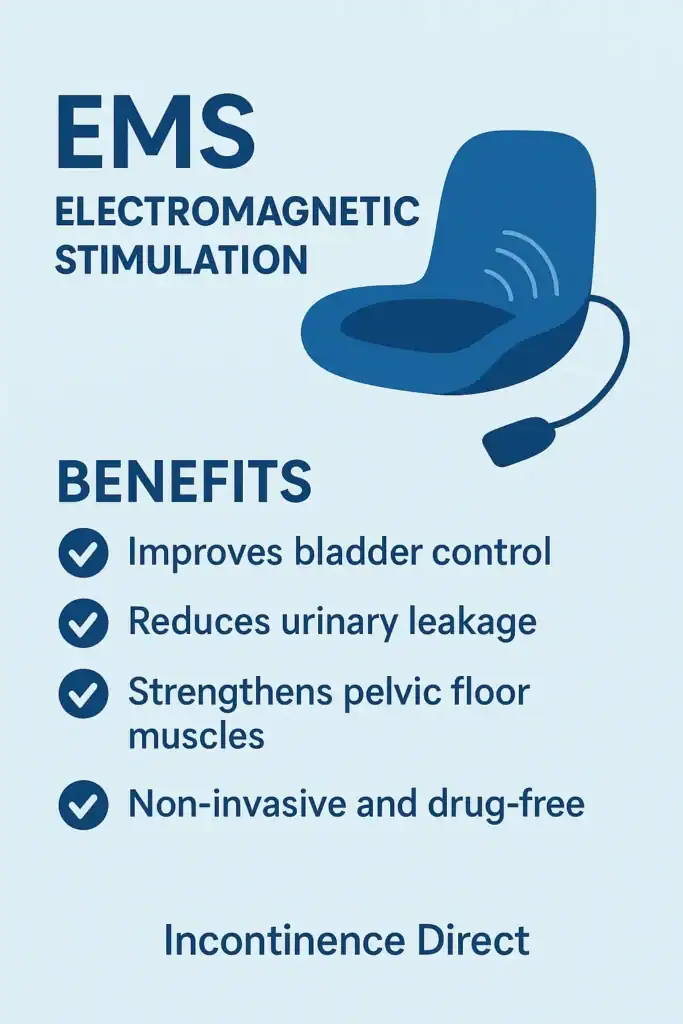
Electromagnetic pelvic-floor stimulation is delivered externally while the person remains seated.
The equipment produces electromagnetic stimulation intended to cause pelvic-floor muscle contractions. Unlike conventional pelvic-floor exercises, the treatment generates the contractions rather than requiring the person to perform every contraction voluntarily.
That difference is one reason researchers have studied the approach in pelvic-floor rehabilitation.
It is also important to distinguish the treatment itself from the claims sometimes made about it. Producing pelvic-floor contractions does not automatically tell us how much someone’s leakage will change, whether the underlying cause has been addressed or whether the treatment is appropriate for that person.
Researchers should consider the intervention, the people included in the study, the treatment schedule, and the outcomes measured.
What Is EMS Therapy for Incontinence?
At Incontinence Direct Kingston upon Hull, the EMS is a service that provides electromagnetic pelvic-floor stimulation delivered using an electromagnetic seat.
During treatment, the person sits on the seat while the equipment delivers the stimulation.
The published evidence surrounding electromagnetic and magnetic stimulation includes several different systems. Some studies use the term HIFEM, others describe extracorporeal magnetic stimulation, and other research investigates different forms of stimulation.
Those terms should not automatically be treated as interchangeable.
For this reason, the most accurate way to describe the service is private electromagnetic pelvic-floor stimulation, while research can be discussed according to the specific intervention studied.
The basic treatment format
- Treatment is delivered externally while seated.
- Electromagnetic stimulation produces repeated pelvic-floor muscle contractions.
- The person does not need to perform every contraction voluntarily.
- Researchers have investigated magnetic or electromagnetic stimulation for urinary incontinence.
- Research protocols vary between studies.
- You can’t predict an individual’s response based on a study involving a different device or treatment programme.
What Types of Urinary Leakage Are There?
Understanding the type of leakage is more useful than treating all bladder leaks as the same problem.
Stress urinary incontinence
Stress urinary incontinence occurs when urine leaks during activities that put extra pressure on the bladder.
Coughing, sneezing, laughing, lifting and exercise are common examples.
Pelvic-floor muscle training has an established role in its management. NICE recommends a supervised pelvic-floor muscle training programme lasting at least three months as first-line treatment for women with stress or mixed urinary incontinence.
Urgency urinary incontinence
Urgency urinary incontinence involves leakage associated with a sudden need to pass urine that is difficult to postpone.
It is often discussed alongside overactive bladder symptoms such as urgency, increased frequency and waking during the night.
For women with urgency or mixed urinary incontinence, NICE recommends bladder training lasting at least six weeks as first-line treatment.
Mixed urinary incontinence
Mixed urinary incontinence combines stress and urgency-related leakage.
Someone might leak while exercising one day and then leak because they could not reach the toilet quickly enough another day.
The predominant symptoms help determine the initial treatment approach.
The Research Behind Electromagnetic Stimulation
Researchers have investigated magnetic stimulation for urinary incontinence for several years.
One multicentre randomised, sham-controlled trial involved 151 women with urgency urinary incontinence. The study used an armchair-type magnetic stimulator, with treatment twice a week for six weeks. The researchers reported greater reductions in weekly leakage and urgency episodes in the active-treatment group than in the sham group.
That is useful evidence because the study included a sham comparison. It still relates to the particular magnetic stimulation system and protocol used in that trial.
A broader systematic review and meta-analysis published in 2018 included 20 studies involving 1,019 people with pelvic-floor dysfunction. Four randomised trials comparing magnetic stimulation with sham treatment did not show significant improvements in several measures, including ICIQ-SF score, quality of life and number of leakages. The authors concluded that the evidence was not convincing enough to establish magnetic stimulation as a treatment for pelvic-floor dysfunction and called for larger, better-designed studies.
More recent research has produced a different picture for some urinary outcomes.
A 2025 systematic review and meta-analysis examined high-intensity focused electromagnetic therapy in women with urinary incontinence and included seven studies. The pooled results showed reductions in urinary-incontinence episodes and improvements in ICIQ-UI SF scores compared with control groups. However, some pelvic-floor contraction measures did not differ significantly between groups. The review also identified variation between studies and possible bias.
This is why the evidence should not be reduced to a simple claim that “EMS stops leaks”.
There is research worth considering, but the findings depend on the intervention and study design.
What the Evidence Means for Someone Considering EMS
A clinical study tells us what happened under the conditions used in that study.
It does not establish what will happen to every person who uses another treatment system.
For example, the 151-person urgency-incontinence trial used a particular armchair magnetic stimulator, a defined magnetic flux density and a specific twice-weekly schedule.
The evidence collected in the 2025 HIFEM review came from seven studies, but the research was far from uniform. Differences across the studies contributed to substantial heterogeneity, and the reviewers also raised concerns about possible bias in the available evidence.
Looking only at a success percentage can miss some of the important differences between the two approaches.
If you are researching treatment, useful questions include:
- What type of stimulation does the equipment use?
- Which published studies involved a comparable intervention?
- Were the people in those studies experiencing the same type of incontinence?
- What outcome did the researchers actually measure?
- How long was the treatment programme?
- Did the study include a comparison or sham-treatment group?
- How does the treatment fit alongside established care?
With pelvic-floor muscle training, the person actively contracts the muscles as part of the exercise programme. Electromagnetic stimulation produces pelvic-floor contractions through the treatment device while the person remains seated.
EMS Compared With Established Pelvic-Floor Treatment
Electromagnetic stimulation and pelvic-floor muscle training work differently.
With pelvic-floor muscle training, the person learns to contract and relax their own muscles. NICE recommends appropriate supervision so that the ability to contract and relax can be assessed and the programme adapted to the individual’s needs.
With electromagnetic stimulation, the device generates a magnetic field while the person sits on the treatment chair, producing involuntary pelvic-floor muscle contractions.
| Treatment approach | How it works | Where it fits |
| Electromagnetic pelvic-floor stimulation | External stimulation produces pelvic-floor muscle contractions while the person remains seated | A treatment approach that has been investigated in urinary incontinence; evidence varies by intervention and study |
| Supervised pelvic-floor muscle training | The person learns to contract and relax the pelvic-floor muscles through a structured exercise programme | NICE recommends at least 3 months as first-line treatment for women with stress or mixed urinary incontinence |
| Bladder training | A structured programme works on bladder habits and the interval between urgency and going to the toilet | NICE recommends at least 6 weeks as first-line treatment for women with urgency or mixed urinary incontinence |
| Medicines | Depending on the diagnosis, medicines may be used to manage urinary symptoms | Considered according to symptoms, medical history and response to other approaches |
| Specialist procedures | Further interventions may be considered when conservative treatment has not provided enough benefit or is unsuitable | The appropriate procedure depends on the type and cause of the incontinence |
The treatments shown in the table are not alternatives that can be ranked against one another. Their use depends on the type of incontinence, the symptoms being treated and the findings from an individual assessment.
Why Pelvic-Floor Training Still Matters
Pelvic-floor training remains an important part of urinary incontinence management.
NICE recommends supervised pelvic-floor muscle training for women with stress or mixed urinary incontinence for at least three months. The programme should be tailored to the person’s ability to contract and relax the muscles.
It is also useful to remember that pelvic-floor function is not simply about strengthening the muscles.
The muscles need to contract when continence is required and relax when the bladder needs to empty. Some people have difficulty identifying the correct muscles, while others have problems with relaxation or coordination.
That is one reason professional assessment can be useful when exercises are difficult or symptoms continue.
What a Treatment Session Involves
If you enquire about electromagnetic pelvic-floor stimulation through Incontinence Direct, you can ask how the equipment works, what an appointment involves and how the mobile service is arranged.
The treatment is delivered while seated.
The exact session length and treatment schedule should follow the actual equipment and service protocol. Research studies have used different treatment durations and frequencies, so a study protocol should not automatically be presented as a universal course for every customer.
If your symptoms have not previously been assessed, particularly if they are new or unexplained, a GP or other appropriate healthcare professional can help establish what type of urinary problem you may have.
If symptoms change or continue despite treatment, further assessment may be appropriate.
Other Things That Can Affect Bladder Leaks
Pelvic-floor function is only one part of urinary health.
Caffeine, fluid intake, constipation, body weight, medicines and some medical conditions can influence urinary symptoms.
NICE recommends a trial of caffeine reduction for women with overactive bladder and advises reviewing fluid intake when it is unusually high or low. It also recommends weight loss for women with urinary incontinence or overactive bladder who have a BMI above 30.
The NHS also recommends looking at factors such as fluid intake, caffeine, alcohol, constipation and weight as part of managing urinary incontinence. (NHS)
A change in drinking habits should not mean severely restricting fluids. Too little fluid can concentrate urine and may make some bladder symptoms worse.
When Bladder Leakage Needs Medical Assessment
Urinary incontinence is common, but it should not automatically be assumed to be caused by weak pelvic-floor muscles.
A GP may ask about the circumstances of the leakage, how often you urinate, whether urgency is involved, medicines, fluid intake and other symptoms. A bladder diary can also help identify patterns.
Medical assessment is particularly important if you have:
- Blood in the urine
- Pain or burning when passing urine
- Repeated urinary infections
- Difficulty starting or maintaining the urine stream
- Difficulty emptying your bladder
- New or rapidly worsening leakage
- New neurological symptoms
- Urinary symptoms following surgery or another medical procedure
NICE recommends further assessment in a range of circumstances, including persistent bladder or urethral pain, voiding difficulties and suspected neurological disease.
Frequently Asked Questions (FAQ) About EMS Therapy
What is EMS therapy for incontinence?
Incontinence Direct Kingston upon Hull uses EMS to refer to its electromagnetic pelvic-floor stimulation service. The treatment is delivered externally while the person remains seated, with the equipment producing pelvic-floor muscle contractions.
Has EMS been studied in clinical research?
Yes.
Research includes randomised sham-controlled trials of magnetic stimulation and more recent systematic reviews of HIFEM and other magnetic stimulation approaches. The results are not completely consistent, and the interventions and protocols vary between studies.
Is EMS a replacement for pelvic-floor exercises?
No. Pelvic-floor muscle training has a well-established place in managing stress and mixed urinary incontinence. NICE recommends a supervised programme lasting at least three months as first-line treatment for women with these types of incontinence.
How many EMS sessions are needed?
There is no single number that applies to every electromagnetic stimulation system.
Research studies have used different schedules, so the programme offered by a private service should correspond to the actual equipment and service protocol.
Can EMS treat stress and urgency incontinence?
Magnetic and electromagnetic stimulation have been studied in different urinary-incontinence populations, including stress and urgency urinary incontinence.
The evidence should be matched to the type of incontinence and the intervention studied rather than treating all urinary leakage as one condition.
Is EMS suitable for everyone?
Suitability cannot be assumed from the presence of urinary leakage alone.
The person’s medical circumstances and the safety information for the actual equipment need to be considered. If there is uncertainty, obtain appropriate medical advice before treatment.
How quickly should I expect improvement?
There is no reliable universal timetable.
Different studies have used different treatment programmes and measured outcomes at different points. A published study should not be turned into a promise that an individual will notice improvement after a particular number of weeks.
Can Incontinence Direct diagnose my bladder problem?
The service should not be presented as a substitute for medical diagnosis.
If your leakage is new, unexplained or has not been assessed, speak with a GP or another appropriate healthcare professional.
Can EMS stop bladder leaks?
Published research has investigated magnetic and electromagnetic stimulation for urinary incontinence, and some studies have reported improvements in leakage or other urinary outcomes.
That research does not establish that every electromagnetic treatment will stop leakage in an individual.
Is electromagnetic stimulation the same as electrical stimulation?
No.
They use different methods of delivering stimulation.
This distinction matters when reading medical research. Evidence concerning electrical stimulation should not automatically be presented as evidence for an electromagnetic chair.
Can men use electromagnetic pelvic-floor stimulation?
Men can experience urinary incontinence and pelvic-floor problems, including symptoms following prostate treatment.
However, much of the urinary-incontinence research cited in this article involves women. Evidence from women should not simply be presented as evidence of the same outcome in men.
How long does an EMS session take?
There is no universal session length across electromagnetic stimulation systems.
The appropriate duration depends on the equipment and treatment protocol being used.
Can I use EMS if I have mixed urinary incontinence?
Mixed incontinence contains both stress and urgency symptoms.
NICE recommends supervised pelvic-floor muscle training for women with stress or mixed urinary incontinence and bladder training for women with urgency or mixed urinary incontinence. Which symptoms predominate matters when deciding on treatment.
Can EMS treat bowel incontinence as well?
Magnetic stimulation has been investigated in faecal incontinence, but the evidence is separate from the urinary-incontinence research.
A small 2020 study investigated functional extracorporeal magnetic stimulation in 30 people with faecal incontinence. The results cannot be automatically transferred to every electromagnetic chair or treatment service.
Does the research prove that an EMS chair is better than surgery?
No.
Surgery and electromagnetic stimulation are different treatment approaches, used in different clinical circumstances. The appropriate treatment depends on the type, severity and cause of the incontinence and the response to previous management.
Choosing What to Do About Bladder Leaks
There is no need to treat every bladder leak as though it has the same cause.
The circumstances surrounding the leakage, other urinary symptoms, medical history and previous treatment all matter.
Electromagnetic pelvic-floor stimulation is one approach that has been investigated in clinical research. Established options such as supervised pelvic-floor muscle training and bladder training also have clear places in current NICE guidance.
If you are considering private EMS treatment, understanding both sides of that picture gives you a more useful basis for deciding what you want to explore.
Speak To Our Team
If you would like to find out more about private electromagnetic pelvic-floor stimulation, you can contact Incontinence Direct to discuss the service and practical arrangements.
If you have not had persistent or unexplained urinary symptoms assessed, consider speaking with an appropriate healthcare professional.
Sources & Further Reading
- NHS — Urinary incontinence
- NHS — Urinary incontinence: treatment
- NICE — Urinary incontinence and pelvic organ prolapse in women: management (NG123)
- NICE — Urinary incontinence in women: supervised pelvic-floor muscle training
- PubMed — Multicenter, randomised, sham-controlled study on the efficacy of magnetic stimulation for women with urgency urinary incontinence
- PubMed — The effectiveness of magnetic stimulation for patients with pelvic floor dysfunction: a systematic review and meta-analysis
- PubMed — Noninvasive High-Intensity Focused Electromagnetic Therapy in Women With Urinary Incontinence: A Systematic Review and Meta-Analysis
- PubMed — Rehabilitation effect of magnetic stimulation on female stress urinary incontinence: a systematic review and meta-analysis
Medical Information Notice
This article provides general information about urinary incontinence and research into electromagnetic pelvic-floor stimulation.
It does not diagnose the cause of urinary leakage or determine whether a particular treatment is appropriate for an individual.
If you have new, persistent, worsening or unexplained urinary symptoms, seek advice from an appropriate healthcare professional.
Individual responses to treatment vary, and research findings should not be interpreted as a guarantee of outcome.
Last Reviewed: September 2026 | Incontinence Driect Editorial Team