

Struggling with Nighttime Leaks Kingston upon Hull? Here’s What is Going On, and What are Your Options

Waking up to a wet bed is different from simply waking because you need to use the toilet. Some people experience both.
Night-time urinary problems can take several forms. You might wake repeatedly because you need to pass urine, feel a sudden urge and struggle to reach the toilet in time, or lose urine while still asleep. These symptoms can occur together, but they do not necessarily have the same cause.
The term nocturia describes waking during the night to urinate. Night-time urinary leakage is different: urine is lost unintentionally while asleep or around the time of waking.
Understanding which pattern you have is useful because treatment depends on the underlying problem.
Struggling With Nighttime Leaks? Start by Working Out What Is Happening
Not every disturbed night points to the same bladder problem.
You may wake once or several times because your bladder feels full. You may wake because of an urge to urinate and then discover that you have already leaked. In other cases, the leakage itself is what wakes you.
There is also a difference between nocturia and nocturnal enuresis. Nocturia means waking from sleep, just to pass urine. Nocturnal enuresis refers to involuntary urination during sleep.
These distinctions matter because several things can contribute to night-time urinary symptoms.
For example, producing more urine during the night, an overactive bladder, a urinary infection, diabetes, certain medicines and prostate problems can all play a role. Sleep-related problems and conditions that cause fluid to collect in the legs can also contribute to nocturia.
If you regularly wake several times a night to urinate, or you are experiencing new leakage during sleep, the pattern is worth investigating rather than assuming that a weak pelvic floor is the only explanation.
What can night-time urinary symptoms look like?
You might notice:
- Waking once or several times to pass urine.
- A sudden urge to urinate during the night.
- Leakage before reaching the toilet.
- Wetting the bed while asleep.
- Needing to change clothing or bedding
- Poor sleep because you are repeatedly getting up
- Daytime tiredness after several disrupted nights
Nocturia is particularly common as people get older, but frequent night-time urination should not automatically be dismissed as an unavoidable part of ageing.
Even these initial steps can reduce leakage episodes, help you sleep more soundly.
Why Nighttime Leaks Can Happen

There are several possible explanations for night-time urinary symptoms.
Producing more urine at night
The kidneys continue producing urine while you sleep. The amount can increase for several reasons, including drinking a large amount of fluid late in the evening.
Some medical conditions can also alter how much urine is produced overnight.
Overactive bladder and urgency
An overactive bladder can cause urgency, frequency and nocturia, with or without urinary leakage.
If the bladder contracts before it has filled sufficiently, you may wake with a strong need to urinate.
Urinary infection
A urinary tract infection can cause increased frequency and urgency, including during the night. Burning or pain when passing urine, cloudy urine, blood in the urine, lower abdominal pain or feeling unwell can also occur.
New urinary symptoms accompanied by these signs should be assessed rather than treated as ordinary night-time leakage.
Prostate-related urinary problems
Men can develop urinary symptoms when an enlarged prostate affects bladder emptying. This can lead to more frequent urination, including at night.
Difficulty starting to urinate, a weak stream, dribbling after urination or a weird feeling that the bladder has not emptied properly are useful details to mention during an assessment.
Medicines and other health conditions
Some medicines can increase urine production or alter bladder symptoms.
Diabetes, heart and circulation problems, neurological conditions and other health issues can also contribute to nocturia or urinary incontinence.
That is why you can’t reliably identify the cause from night-time leakage alone.
The Impact Goes Beyond the Leak
Repeatedly getting out of bed can fragment sleep.
Over time, poor sleep can leave you tired during the day and make ordinary activities harder. There can also be a practical burden: changing bedding, keeping spare clothes nearby or worrying about leakage when staying away from home.
Night-time toilet trips can create another concern. Getting out of bed when you are sleepy, particularly in a dark room, can increase the chance of stumbling or falling.
Making the route to the bathroom clear and keeping suitable lighting nearby can be sensible while the underlying urinary problem is being investigated.
Non-Surgical Ways to Manage Nighttime Urinary Symptoms
The right approach depends on the cause.
For women with urgency or mixed urinary incontinence, NICE recommends bladder training for at least six weeks as first-line treatment.
Bladder training is a structured approach, not simply telling yourself to “hold on”. It involves working on bladder habits. It gradually increases the interval between the urge to urinate and going to the toilet.
A bladder diary can also be useful. NICE recommends that women having an initial assessment for urinary incontinence or overactive bladder complete a diary for at least three days. It can record drinks, urination, leakage, urgency and other details that help reveal a pattern.
Fluid timing
Drinking less immediately before bed can reduce some night-time toilet trips, but deliberately avoiding fluids throughout the day is not a good general solution.
The NHS advises people with nocturia to consider reducing drinks in the hours before bed while still drinking enough during the day.
Caffeine and alcohol
Tea, coffee, cola and other caffeinated drinks can increase urinary frequency or urgency in some people. Alcohol can also affect bladder symptoms.
Reducing these drinks, particularly later in the day, may be worth discussing as part of managing urinary symptoms.
Pelvic-floor muscle training
Pelvic-floor training has an established role in managing urinary incontinence.
For women with stress incontinence or mixed urinary incontinence, NICE recommends a supervised pelvic-floor muscle training programme lasting at least three months.
The appropriate exercise depends on the type of incontinence. Night-time leakage should not automatically be treated as a simple pelvic-floor weakness.
Medicines
Medication can sometimes form part of treatment for overactive bladder or nocturia.
The choice depends on the cause and the person’s medical circumstances. For example, NICE says desmopressin may be considered specifically for troublesome nocturia in some women with urinary incontinence or overactive bladder, with important precautions and exclusions.
This treatment needs appropriate clinical assessment rather than self-treatment.
Keeping a Bladder Diary
A three-day bladder diary can reveal things that are difficult to remember from one night to the next.
You can record:
- What you drink and how much or how frequently you drink.
- The time of each drink.
- When you pass urine.
- How much urine you pass, if measuring is practical.
- When urgency occurs.
- Any leakage.
- Whether leakage happens before or after waking.
- How many times you get up during the night.
The pattern can help distinguish between frequent night-time urination and leakage associated with urgency.
It can also give a GP or continence professional useful information when deciding what to investigate.
Where Does Electromagnetic Stimulation Fit?
Electromagnetic pelvic-floor stimulation is another treatment approach that has been investigated in urinary incontinence.
The treatment uses externally delivered electromagnetic stimulation to produce pelvic-floor muscle contractions while the person remains seated.
Research has looked at urinary incontinence and overactive bladder, and some studies have included nocturia among their measured outcomes.
That does not mean that night-time leakage has been established as a specific indication for every electromagnetic chair.
The equipment and treatment protocol matter.
What has the research found?
A 2022 randomised study involved 76 women with idiopathic overactive bladder. One group received bladder training alone and the other received bladder training together with magnetic stimulation using a specific therapy armchair. After six weeks, the combined-treatment group showed greater improvements in several measures, including nocturia, incontinence episodes, symptom severity and quality of life.
This is relevant because the study directly measured nocturia.
It does not, however, show that every electromagnetic chair will produce the same result.
A later randomised sham-controlled trial involving women with urgency urinary incontinence also measured nocturia. At six months, the active magnetic-stimulation group showed greater improvement in several urinary outcomes, including nocturia, than the sham group.
Other research has been less encouraging. A double-blind trial of a different trans-sacral electromagnetic stimulation device in women with overactive bladder found no difference from sham treatment in frequency, nocturia, urinary leakage or quality of life.
The research therefore does not point to a single predictable result. Different forms of magnetic or electromagnetic stimulation, different devices and different treatment protocols have produced different findings.
What This Means If You Are Considering an EMS Chair With Incontinence Direct Kingston upon Hull
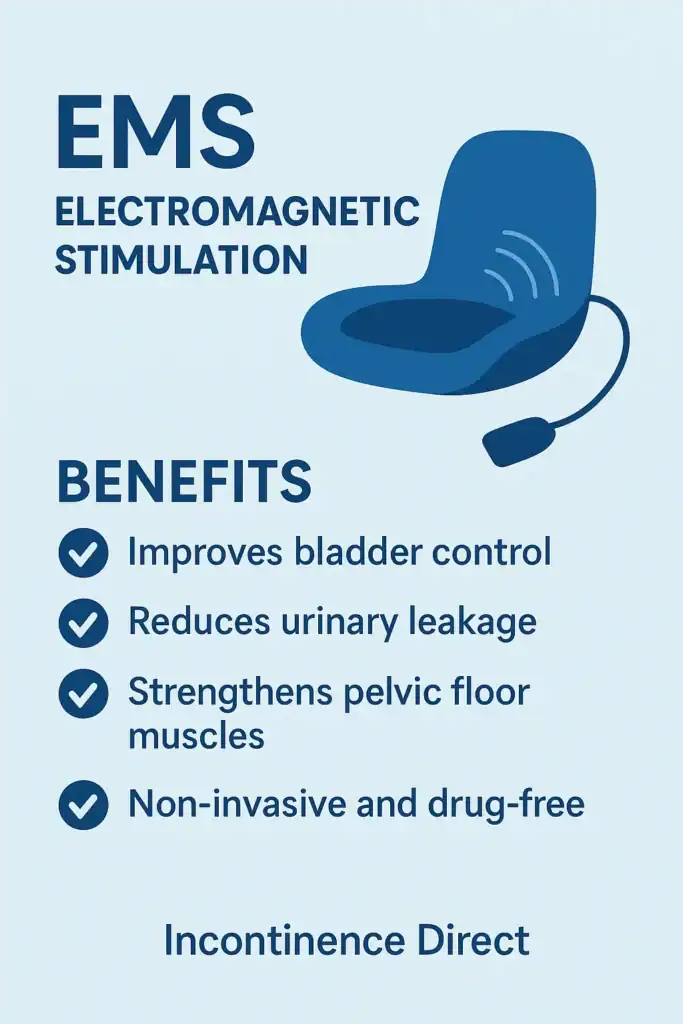
There is a clear distinction between saying that magnetic stimulation has been studied in people with urinary symptoms and saying that a single chair will stop night-time leaks.
The first statement is supported by published research.
The second is an individual-treatment claim that those studies alone cannot establish.
The 2025 systematic review of HIFEM for urinary incontinence included seven studies in women. It found improvements in some urinary outcomes and quality-of-life measures, but also identified substantial variation between studies and possible bias. The authors called for better-quality research and more standardised methods.
For someone considering private treatment, useful questions include:
- What type of electromagnetic stimulation does the equipment use?
- What research has been conducted using comparable equipment?
- Did the study measure nocturia or night-time leakage?
- What treatment schedule was used in the relevant study?
- How does the treatment fit alongside bladder training or pelvic-floor treatment?
- Have they assessed the underlying urinary symptoms?
Those questions are more informative than relying on a promised number of sessions or a fixed timeline for improvement.
A Treatment Appointment
If you decide to enquire about private electromagnetic pelvic-floor stimulation, the appointment process should begin with understanding what you are experiencing and what you want to know about the treatment.
You can ask how the chair works, what the session involves and how appointments are arranged.
If your urinary symptoms have not been assessed, particularly if they are new or unexplained, consider speaking with a GP first. A GP may ask about your urinary pattern, medicines, fluid intake, caffeine and alcohol, difficulty emptying your bladder and other symptoms.
The treatment itself is delivered externally while you remain seated.
The appropriate treatment schedule depends on the actual equipment and service being used. Research studies have used different programmes, so a research schedule should not automatically be treated as the required course for every person.
If your symptoms change or continue despite treatment, further assessment may be appropriate.
Practical Steps for Better Nights
No single bedtime trick solves every cause of nocturia or night-time leakage.
A few practical changes can nevertheless make nights easier while the underlying problem is being addressed.
Keep the route to the bathroom clear
If you are getting up repeatedly, make sure there is a clear path and adequate lighting. This is particularly important if you are sleepy or unsteady when you wake.
Review evening drinks
Large amounts of fluid close to bedtime can increase urine production overnight. Caffeine and alcohol can also affect bladder symptoms.
Do not respond by severely restricting fluids during the day.
Use appropriate night-time protection
Absorbent products and washable or disposable bed protection can reduce disruption from leakage while you work out the underlying cause.
These products manage the practical consequences of leakage; they do not treat its cause.
Record what happens
A bladder diary can show whether you mainly wake to urinate, leak with urgency, or follow another pattern.
That information can make a clinical assessment more useful.
Look for changes
If your night-time symptoms suddenly become much worse, start after a long period without problems, or occur alongside pain, blood in the urine or other new symptoms, seek medical advice.
When Should You Speak to a GP?
The NHS advises people with urinary incontinence to speak to a GP.
An assessment can help identify the type of urinary incontinence and whether another condition could be contributing.
You should particularly seek medical advice if you notice:
- Blood in your urine
- Pain or burning when passing urine
- Repeated urinary infections
- Difficulty starting or maintaining the urine stream
- Difficulty emptying your bladder
- New or rapidly worsening leakage
- Excessive thirst or other symptoms that could indicate a medical condition
- New urinary symptoms after a procedure or surgery
- Symptoms alongside neurological problems
A GP may recommend a urine test, ask you to keep a bladder diary or arrange further assessment depending on the symptoms.
Night-time leakage should not simply be attributed to ageing or a weak pelvic floor without considering other possible causes.
See Our Prices & Current Promotions Here!
Frequently Asked Questions (FAQ) About Treating Nighttime Leaks Kingston upon Hull
What are nighttime urinary leaks?
Nighttime urinary leaks are episodes in which urine is unintentionally lost during sleep or around the time of waking.
They are different from simply waking during the night to use the toilet.
Why am I leaking urine at night?
There are several possible causes, including urgency or overactive bladder, increased urine production at night, urinary infection, medicines, diabetes, prostate problems and other health conditions.
An assessment is the best way to work out which factors may be relevant.
Can drinking less before bed help?
It can help some people if they drink a large amount of fluid close to bedtime.
However, reducing fluids excessively can create other problems. The NHS recommends maintaining adequate fluid intake during the day while considering less fluid in the hours before bed if nocturia is an issue.
Has electromagnetic stimulation been studied for nocturia?
Yes.
Nocturia has been measured in several studies of magnetic stimulation. One randomised trial of women with idiopathic overactive bladder found greater improvement in nocturia when magnetic stimulation was added to bladder training. A later sham-controlled urgency-incontinence trial also reported improvement in nocturia.
The findings are specific to the interventions studied and do not establish a predictable outcome for every electromagnetic treatment system.
Is an EMS chair the same as bladder training?
No.
Bladder training is a behavioural treatment that works on bladder habits and the interval between urgency and going to the toilet.
Electromagnetic stimulation is an externally delivered physical treatment that produces pelvic-floor muscle contractions.
They are different approaches and should not be treated as interchangeable.
Can men experience nighttime urinary leakage?
Yes.
Men can experience nocturia and urinary incontinence for several reasons, including prostate-related urinary problems and other bladder or health conditions.
Persistent or new symptoms should be assessed rather than assumed to be a pelvic-floor issue.
What is nocturia?
Nocturia means waking during the night because you need to pass urine.
Someone can have nocturia without leaking urine. Another person can have nocturia and urgency-related leakage at the same time.
Is waking once at night to urinate abnormal?
Not necessarily.
Night-time urination varies between people and becomes more common with age. What matters is whether it is troublesome, increasing, accompanied by other symptoms or associated with leakage.
Can caffeine make nighttime urination worse?
It can.
Caffeine may increase urinary frequency and urgency in some people and can also interfere with sleep. Reducing caffeine, particularly later in the day, may be worth trying.
Can pelvic-floor exercises help with nighttime leaks?
That depends on the type of urinary problem.
Pelvic-floor muscle training is an established treatment for stress and mixed urinary incontinence. Night-time leakage caused by another condition may need a different approach.
Can an EMS chair stop nighttime leaks?
A guaranteed outcome cannot be promised.
Magnetic and electromagnetic stimulation have been investigated in urinary incontinence, but studies differ in their equipment, treatment schedules, participants and outcome measures.
How many EMS sessions will I need?
There is no single number that applies to every electromagnetic treatment.
Research studies have used different schedules. The programme offered by a private service should correspond to the equipment and service protocol being used.
Can women experience nighttime leakage after childbirth?
Urinary symptoms can occur during or after pregnancy and childbirth, including stress or mixed urinary incontinence.
The appropriate treatment depends on the symptoms and the person’s circumstances. NICE recommends pelvic-floor muscle training as part of management for relevant urinary symptoms.
Ready to Talk About Your Options?
If nighttime leakage or repeated trips to the toilet are affecting your sleep, you can contact Incontinence Direct to ask about private electromagnetic pelvic-floor stimulation.
The service can explain how the treatment is delivered and how to arrange appointments.
If your urinary symptoms have not been assessed, or if they have changed recently, an appropriate medical assessment should come first.
Sources & Further Reading
- NHS — Urinary incontinence
- NHS — Urinary incontinence: Diagnosis
- NHS — Urinary incontinence: Non-surgical treatment
- NICE — Urinary incontinence and pelvic organ prolapse in women: management (NG123)
- NICE — Urinary incontinence in women: Bladder diaries and lifestyle changes
- PubMed — Short-term effect of magnetic stimulation added to bladder training in women with idiopathic overactive bladder
- PubMed — Magnetic Stimulation in the Treatment of Urgency Urinary Incontinence: A Randomized Sham-Controlled Clinical Trial
- PubMed — Noninvasive High-Intensity Focused Electromagnetic Therapy in Women With Urinary Incontinence: A Systematic Review and Meta-Analysis
- PubMed — A prospective randomised double-blind controlled trial evaluating trans-sacral magnetic stimulation in women with overactive bladder
Medical Information Notice
This article provides general information about night-time urinary symptoms, urinary incontinence and research into electromagnetic stimulation.
It does not diagnose the cause of night-time leakage or determine whether a particular treatment is appropriate for an individual.
If your symptoms are new, persistent, worsening or unexplained, seek advice from an appropriate healthcare professional.
Individual responses to treatment vary, and research findings should not be interpreted as a guarantee of outcome.
Last Reviewed: September 2026 | Incontinence Driect Editorial Team